
October in the East Valley feels like a reward. The mornings cool off, the windows can finally open, and the air conditioner gets a break for the first time in months.
That break is a good moment to look at the system that carried you through the summer. Small problems that started in July are easier, and usually less stressful, to fix now than next June.
What a Phoenix-area summer does to your AC
An Arizona summer asks a lot of an air conditioner. For months, the system runs long cycles in extreme heat, often well into the night. Through monsoon season (June 15 to September 30, as defined by the National Weather Service), it also deals with dust storms, power flickers and heavy rain.
All that running adds up. Filters load with dust. The outdoor coil collects dirt and debris, which makes it harder for the unit to shed heat. Electrical parts like capacitors and contactors work hard all season. And the condensate drain line, which carries away the moisture your AC pulls from the air, can build up sludge after a summer of steady use.
None of that means your system is in trouble. It means fall is the right time to check.
A fall AC checklist for East Valley homes
You don’t need tools or technical skills for most of this. Think of it as a walk-around after a long season.
Change or check the air filter
Start here. ENERGY STAR recommends inspecting filters once a month, and a summer of heavy use and monsoon dust can leave a filter much dirtier than the calendar suggests. A clogged filter restricts airflow, and ENERGY STAR notes that airflow problems can reduce a system’s efficiency by up to 15 percent. If you noticed more dust inside the house this summer, our indoor air quality page covers options beyond the standard filter.
Look at the outdoor coil
Walk outside and look at the outdoor unit. Is the coil around the sides coated in dust? Are leaves, plastic bags or yard debris caught against it? Are shrubs or weeds crowding in? Clear the debris and trim anything growing close to the unit so air can move freely.
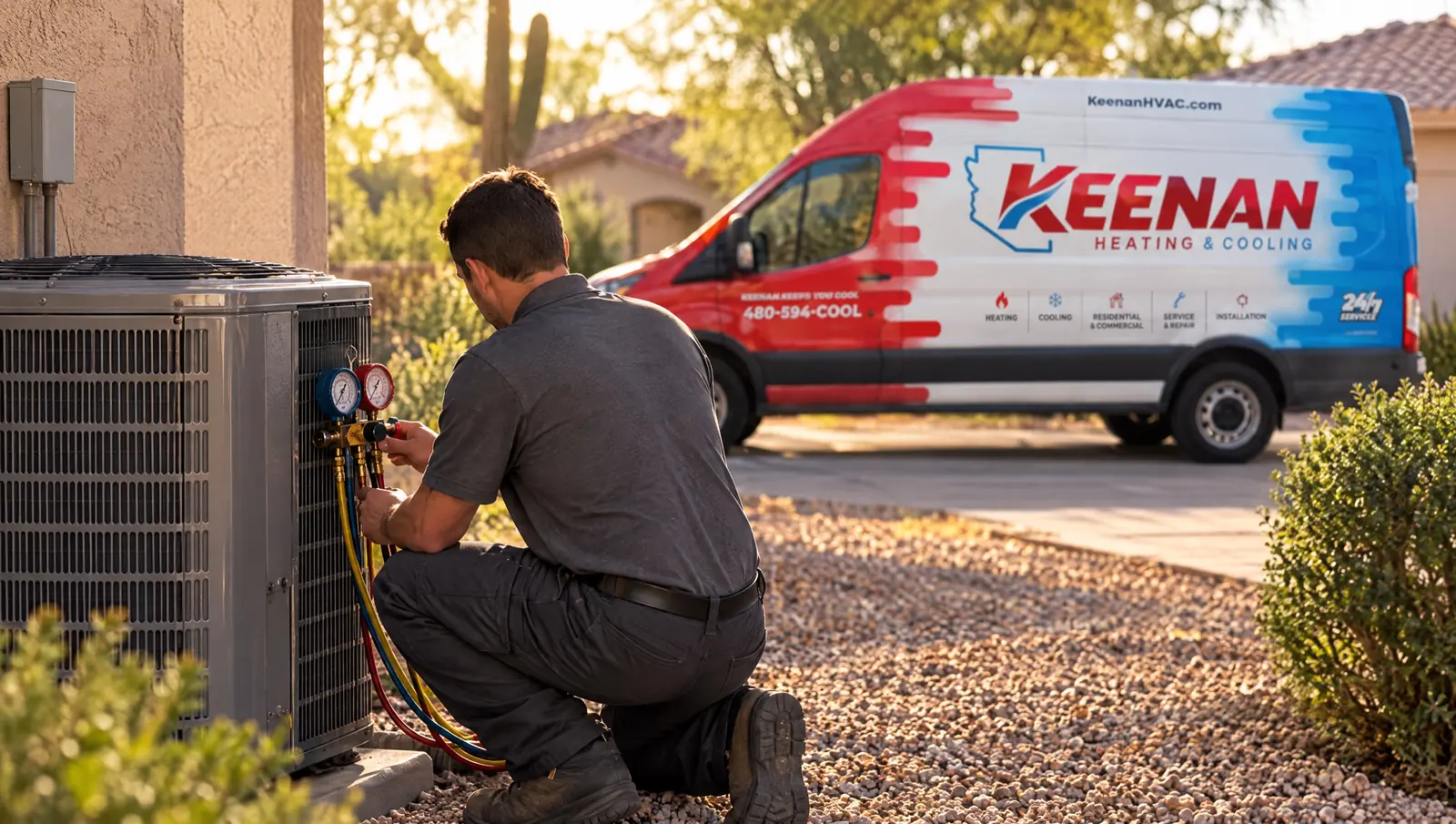
If you rinse the coil yourself, turn the system off at the thermostat and the breaker first, and use a gentle spray from a garden hose. Never a pressure washer. The thin fins bend easily, and bent fins block airflow. A deep coil cleaning is part of a professional tune-up.
Check the condensate drain
Near the indoor unit (often in a garage, closet or attic), you’ll find a drain line that carries water away while the AC runs. Look for standing water, rust, or water stains around the indoor unit. A clogged drain can cause water damage, or trip a safety switch that shuts cooling off. If you see water where it shouldn’t be, have it checked.
Listen and watch for warning signs
Think back over the summer. Did anything change? Maybe the vents blew warm air some afternoons, or a bedroom stopped cooling like it used to. Maybe you heard a new buzz, rattle or grinding noise, saw ice on the refrigerant lines, or reset a breaker more than once. An electric bill that climbed faster than the weather explains counts too. Any of those is worth mentioning to a technician.
Two of these need extra care. Ice or a system that cools poorly can point to a refrigerant problem, and refrigerant work requires a technician certified under EPA’s Section 608 program. Buzzing and breaker trips can point to electrical problems. Please don’t open the outdoor unit’s panels to look: capacitors can hold a dangerous charge even with the power off. If anything on that list sounds familiar, AC repair is the place to start.
Reset your thermostat
Summer schedules don’t fit fall weather. Check that your thermostat’s settings make sense for cooler days, that the clock is right, and, if it uses batteries, replace them. Then make sure it switches to heat properly, which brings us to the other half of your system.
Getting the heating side ready
Our winters are mild, but the East Valley still gets cold nights, and most homes run the heat at least a little. The first time you switch to heat each year, a faint dusty smell for a few minutes can be normal as dust burns off. A smell that lingers, or anything that smells like gas, is not. If you smell gas, leave the house and call your gas utility or 911 from outside.
If your home has a gas furnace, its yearly check matters for safety, not just comfort. ENERGY STAR’s maintenance checklist calls for checking gas connections, gas pressure, burner combustion and the heat exchanger, because faulty gas connections are a fire hazard and a cracked heat exchanger can affect your health. It’s also a good time to test your carbon monoxide alarms. The U.S. Consumer Product Safety Commission recommends battery-operated CO alarms, or alarms with battery backup, on every level of the home and outside sleeping areas.
Heat pump owners have one system for both seasons, so a fall check should confirm it switches from cooling to heating correctly, and that any backup heat works. Our heating services page covers furnaces and heat pumps.
Why fall is a smart time to fix small problems
Here’s the practical case for fall. A worn capacitor, a slow refrigerant leak or a partly clogged drain might limp through a mild October without anyone noticing. Next June, when the system is running all day, that same small problem can turn into a breakdown on the hottest afternoon of the week.
Fixing it now means you get to decide when the work happens. It also gives you time to think, without a hot house pushing you, if a technician finds that an older system is nearing the end of its life. In neighborhoods where many homes were built in the same few years, like much of San Tan Valley, plenty of original systems are reaching that age at once.
A fall tune-up is the easiest way to cover all of this. If you want to know exactly what a thorough one includes, our post on what an AC tune-up should include walks through each step.
Make it routine with the Keenan Comfort Club
If you’d rather not keep track of the seasons yourself, the Keenan Comfort Club is our maintenance plan for planned seasonal care of your heating and cooling system. Ask us about the current membership options for your home.
Keenan Heating & Cooling is a local, family-owned company serving Chandler, Gilbert, Mesa, Queen Creek and San Tan Valley. Call (480) 594-2665 or request service online to schedule a fall check before the cold nights, and well before next summer.
Sources
- National Weather Service Phoenix, Monsoon Awareness (season June 15 through September 30): https://www.weather.gov/psr/monsoonawarenessweek
- ENERGY STAR, Maintenance Checklist (monthly filter inspection; airflow up to 15 percent; condensate drain; gas connections, pressure, burner combustion and heat exchanger): https://www.energystar.gov/saveathome/heating-cooling/maintenance-checklist
- U.S. EPA, Refrigerant Sales Restriction, Section 608: https://www.epa.gov/section608/refrigerant-sales-restriction
- U.S. CPSC, Carbon Monoxide Information Center (CO alarms on every level and outside sleeping areas): https://www.cpsc.gov/Safety-Education/Safety-Education-Centers/Carbon-Monoxide-Information-Center
- San Tan Valley growth after 2000: https://en.wikipedia.org/wiki/San_Tan_Valley,_Arizona